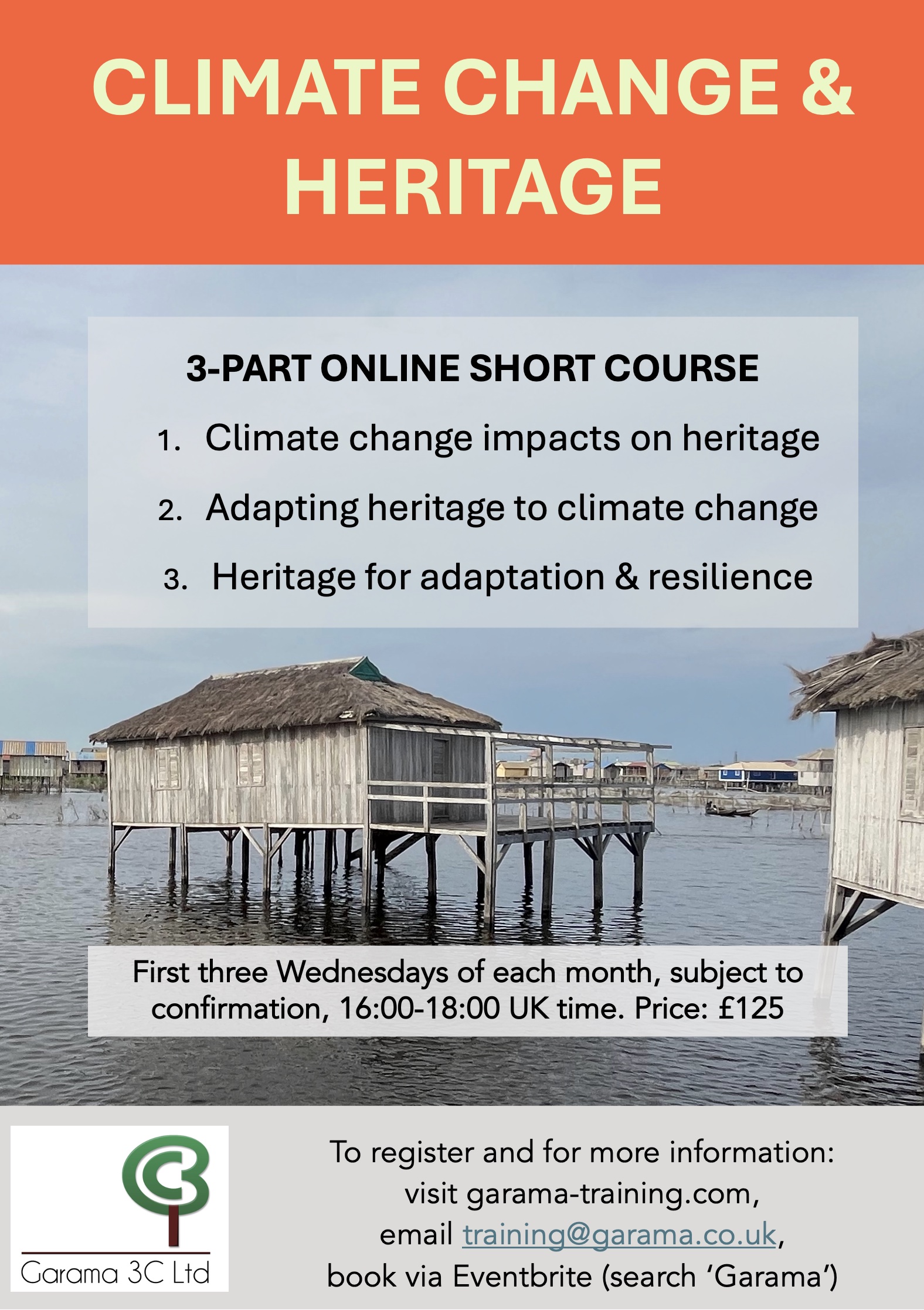
This course consists of three sessions addressing (i) climate change impacts on heritage, (ii) adapting heritage, and (iii) the role of heritage in adaptation and resilience. It runs as an online course, with one 2-hour session a week for three weeks. We can also run this course in-person for organisations on request, with content tailored to specific contexts and audiences. Download and share a flyer.
Climate change impacts on heritage
This sessions looks at the impacts of climate change on tangible and intangible heritage, including natural heritage and practices associated with heritage locations. It examines how climate change affects aspects of intangible heritage such as traditional knowledge and cultural identity, through direct and indirect impacts. This session draws on diverse examples, including built heritage, coastal heritage, rock art. The combined impacts of climate change and other stresses such as economic development and conflict are examined, with a focus on intangible heritage.
Adapting heritage
In this session, we look at how the custodians of heritage can respond to climate change and its impacts. What practical adaptation responses can be taken to preserve tangible heritage and heritage sites? What can be done when the preservation of heritage sites or locations is impractical or impossible? How can we preserve, transmit and update traditional knowledge, skills and practices in the face of climate change? What happens when such intangible heritage is embedded in contexts and livelihoods that are existentially threatened by climate change? Who should be involved in the development of responses to such threats? We look at the idea of ‘curating transformation,’ how this is relevant in the context of climate change, and how it can make heritage more relevant to adaptation at large.
Heritage for adaptation and resilience
Multiple studies have highlighted how adaptation interventions often fail or make things worse because they pay insufficient attention to local contexts, entrench existing inequalities, and ‘crowd-out’ local solutions. Heritage includes traditional practices, skills and knowledge, including knowledge of the local environment and skills in managing environmental challenges. In this session, we look at how integrating culture and heritage into adaptation can lead to better adaptation outcomes by increasing the relevance of adaptation actions, enhancing local ownership and sustainability, and leveraging local capacity and knowledge for better adaptation design. We look at how culture mediates responses to climate change, facilitating and constraining adaptation, and at how threats to heritage can act as catalysts for wider adaptation action.
This course is run by Dr. Nick Brooks and Prof. Joanne Clarke. Check dates and pricing, or contact us to register or express an interest in attending the course